
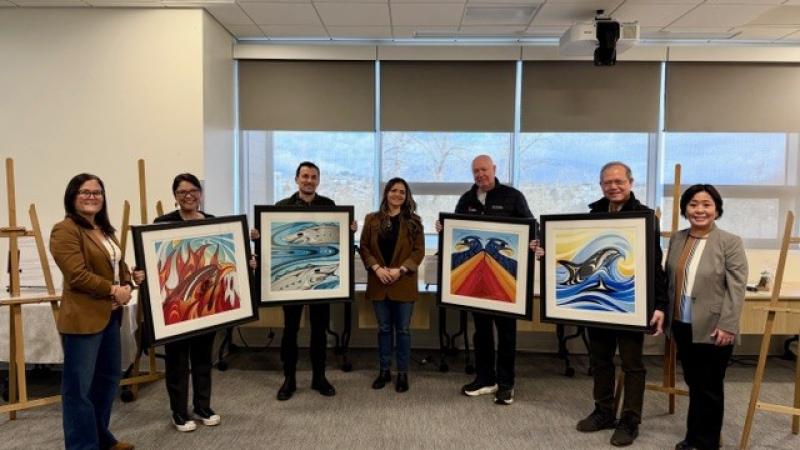
The City of Burnaby is proud to celebrate an exciting project with renowned Musqueam artist Kelly Cannell. This project marks an important step in advancing reconciliation and building cultural safety in Burnaby.
City staff collaborated with Kelly to illustrate four of Burnaby’s highest-risk hazards: fire, flood, earthquakes and tsunamis. Her artwork tells a visual story of the relationship between land, water, and the people who have lived with these natural forces since time immemorial.
The original designs will help communicate the City’s Emergency Management principles and support activities across all phases of emergency management: mitigation, preparedness, response, and recovery. The artworks are accompanied by translations in both hən̓q̓əmin̓əm̓ and Sḵwx̱wú7mesh sníchim, providing an opportunity to learn about the Host Nations’ experiences with and understanding of these hazards.
The City thanks Kelly for sharing her cultural knowledge, artistic talent and guidance throughout this project. Her inspiring work invites us to reflect on the resilience and teachings of the Coast Salish Peoples and how traditional knowledge can deepen our understanding of hazards and risk mitigation, while supporting cultural safety and humility.
We also acknowledge the Province of British Columbia’s Indigenous Engagement Requirement Funding Program for funding this project and thank the Province for its support.
As a City, we are committed to advancing reconciliation by building and maintaining positive relationships to meaningfully do this important work together—and we look forward to continuing on this path.
To learn about local hazards, while exploring Indigenous art and culture, click on each image to discover the meaning and story behind the artwork.
About the artist
Kelly Cannell is a celebrated Indigenous Coast Salish artist from the Musqueam Nation in Vancouver, B.C., whose dynamic and thought-provoking works embody a deep connection to her culture and the natural environment. Drawing from the rich traditions of the Coast Salish Musqueam community, her art combines intricate detail and vivid colour, while exploring innovative approaches to traditional themes.
Her passion for glass art has taken her to prominent institutions such as the Pilchuck Glass School in Washington and The Glass Furnace in Istanbul, Turkey. In 2019, she earned a contemporary art scholarship, granting her the opportunity to collaborate with master glassblowers at the Berengo Glass Studio in Murano, Italy. Kelly also refined her skills in silk screen printing and acrylic painting at Emily Carr University, blending traditional and modern techniques to create works that are both deeply rooted in her heritage and strikingly original.
Kelly’s public art installations are featured across Greater Vancouver and beyond, reflecting her commitment to environmental themes, cultural preservation, and community engagement. Her work raises awareness about the importance of stewardship while honouring Coast Salish traditions. In 2024, she received the prestigious Polygon BC Achievement First Nations Art Award, further solidifying her influence in the Canadian art scene. With additional installations planned, her impact continues to grow. Through her artistry, she continues to preserve and evolve Coast Salish traditions, inspiring audiences while bridging the past with the future.
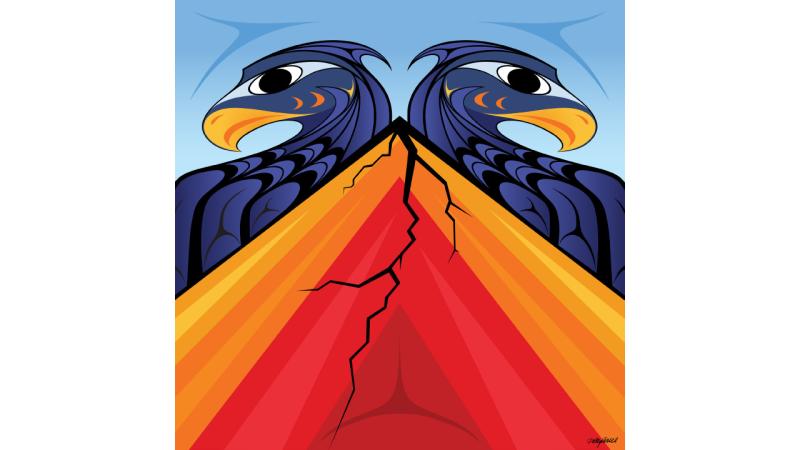
Earthquake - kʷəyχtəm tə təməxʷ / yátshen nékwem ta temíxw
This artwork conveys the force of an earthquake through two Thunderbirds rising behind a fractured mountain peak. In Coast Salish teachings, the Thunderbird is a powerful being whose wingbeats bring crashing storms, rolling thunder, and lightning flashing from its eyes. Its legacy tells of a great spirit dwelling high in the mountains, descending with immense strength — each flap of its wings disrupting the earth below. In placing the Thunderbirds as the central figures, the design reflects their enduring role within Coast Salish cultural narratives, where they are associated with dramatic changes in weather and the land. The mountain peak below incorporates a series of triangular forms, weaving-inspired patterns that represent a traditional mountain-and-valley motif, visually expressing the rise and fall of the landscape. Rather than interpreting the earthquake strictly as a spiritual event, the composition shows how traditional stories and design elements connect to powerful forces found in nature. The fractured mountain, patterned peaks, and rising Thunderbirds emphasize movement, impact, and the deep relationship between the land, its natural shifts, and the cultural knowledge used to understand the world.

Flood - p̓i:ltstəm / mimúy
This design represents flood through two Sturgeon swimming through rising waters. The water is depicted in shifting hues of blue, capturing its changing depths, movement, and the dynamic nature of the waters — both as a life-giving force and as a potential hazard. Sturgeon have long been a vital food source for Coast Salish communities, particularly along the Fraser River, which connects communities across the Lower Mainland and farther north. Once abundant, these ancient fish sustained generations, and Sturgeon legends continue to be carried through the oral traditions of the people. Beyond their role providing sustenance, Sturgeon symbolize wealth and resilience, reflecting longevity while carrying lessons through time. A significant story from the Musqueam community reflects the Sturgeon’s deep cultural and spiritual presence. By placing Sturgeon at the heart of the composition, the artwork links the rising waters to the river itself — a waterway that binds communities together — while honouring the Sturgeon as a guardian and sustainer within Coast Salish culture. The piece reflects both the power of flooding and the strength, abundance, and resilience embodied by the Sturgeon.
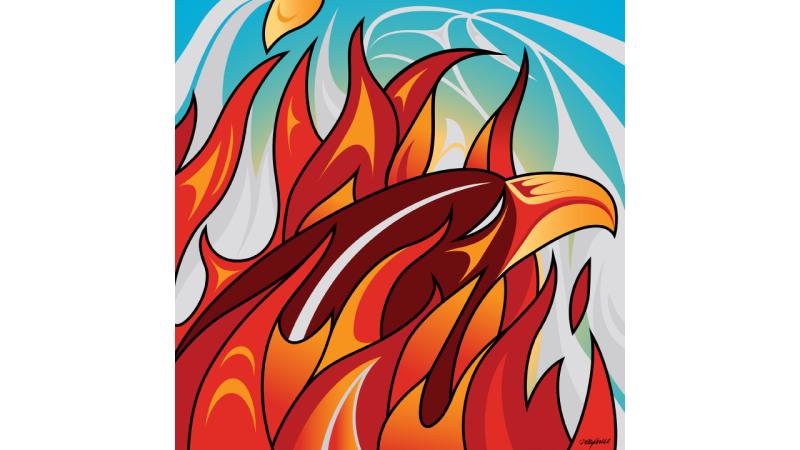
Fire - qəlcəp (bad fire) / yíy̓ulh
This artwork depicts an Eagle emerging from within flames, a vivid representation of the power of fire. In Coast Salish culture, the Eagle is a profound symbol of power, wisdom, and prestige. Revered as a master of the skies and a messenger between realms, the Eagle carries prayers and teachings, offering guidance and insight. It embodies strength, vision, and the ability to lead and inspire. In this composition, the Eagle and the fire are inseparably intertwined, reflecting fire’s dual nature: a force that can destroy, purify, or renew. The Eagle’s presence within the flames emphasizes fire as a living, dynamic element, guided by strength and awareness. The design captures fire’s movement, its unpredictable energy, and its capacity to consume and regenerate, illustrating its powerful and transformative role in the natural world.
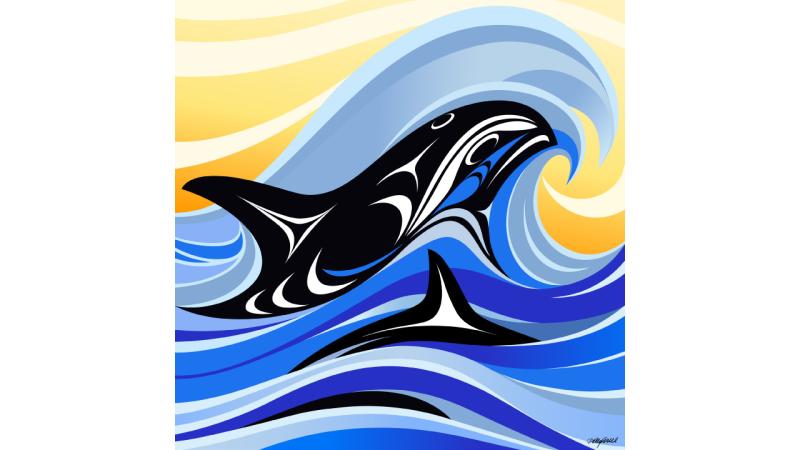
Tsunami - sqʷɬel̕əqa:ɬcə (giant waves against the beach) / hiyúnexw
This depiction of a tsunami features an Orca — guardian of the sea — emerging within a rising wave, with its pod breaching close by. In Coast Salish culture, the Orca holds deep meaning as a symbol of power, protection, family, and connection. Its presence reflects teachings about unity, respect for the natural world, and the strength found in caring for one another. Legends tell of humans turning into Orcas, becoming one with their ocean relatives. By using the Orca as the central presence, the artwork reflects the immense force of a tsunami while honouring the relationship between people and the waters that surround them. The imagery conveys both the strength of the ocean and the enduring bonds within the waters, emphasizing the cultural significance of the Orca as a being deeply tied to the rhythms, teachings, and responsibilities of the sea.