
Swim Lessons
Learning to swim is an important life skill
It’s fun, great for your health and puts you on a path to an active lifestyle. Burnaby offers swim lessons through the Lifesaving Society Swim for Life program.
Registration process for swimming lessons
We are offering more opportunities for swim lesson registration.
- You can register for swim lessons 30 days in advance of the lesson start date at 10 am if you are a Burnaby resident, or 27 days in advance at 10 am if you are not.
- For example, if you want to sign up for swim lessons that begin on September 7, you can register on August 8 at 10 am if you live in Burnaby, or on August 11 at 10 am if you live elsewhere.
- Note: If you are in a current lesson set, your results will be posted by the final day of your lesson set.
Visit WebReg to register. Questions? Please call your local recreation facility.
Reminder: One set at a time
Swimming lesson participants can only be registered for one set of lessons at a time. You can register for the next set of lessons only after the completion of the lesson set you are currently registered in. You may be withdrawn from a swimming program if registered in more than one lesson set.
Parent & Tot
6 months to 3 years old with an adult
Prerequisite: None. Based on age.
Parent & Tot classes provide an opportunity for parents and children to enjoy in-water interaction in a fun and social setting. Focusing on the importance of play and developing water positive attitudes and skills, children gain valuable exposure to being in and around the water. Parents will learn to be Water Smart® to keep themselves and their child safe in any aquatic setting. Activities and progressions in Parent & Tot are based on developmental stages. Register at the appropriate level based on the age of the child
Parent & Tot 1 – Jellyfish (6–12 months)
Parents and babies will explore the water together under the watchful eyes of their instructor. Parents learn how to swim safely with their infant in the pool through instruction of holds and supports. Infants will be introduced to getting their face wet, blowing bubbles and floating with the help of their caregiver.
Parent & Tot 2 – Goldfish (12–24 months)
Instructors lead sessions helping parents learn how to play in the water safely with their child. With the support of their parent/caregiver, toddlers learn how to enter and exit the water, play games encouraging them to get their face wet and blow bubbles in the water, and develop floating and kicking skills.
Parent & Tot 3 – Seahorse (2–3 years)
Parents support their toddlers in becoming more independent in the water. Toddlers learn to safely enter the water wearing a PFD, and develop underwater skills such as submersion and opening their eyes underwater. Through songs and games, toddlers learn ‘starfish’ floats, ‘pencil’ floats and kicking skills in a fun and welcoming environment.
Preschool
3 to 5 years old
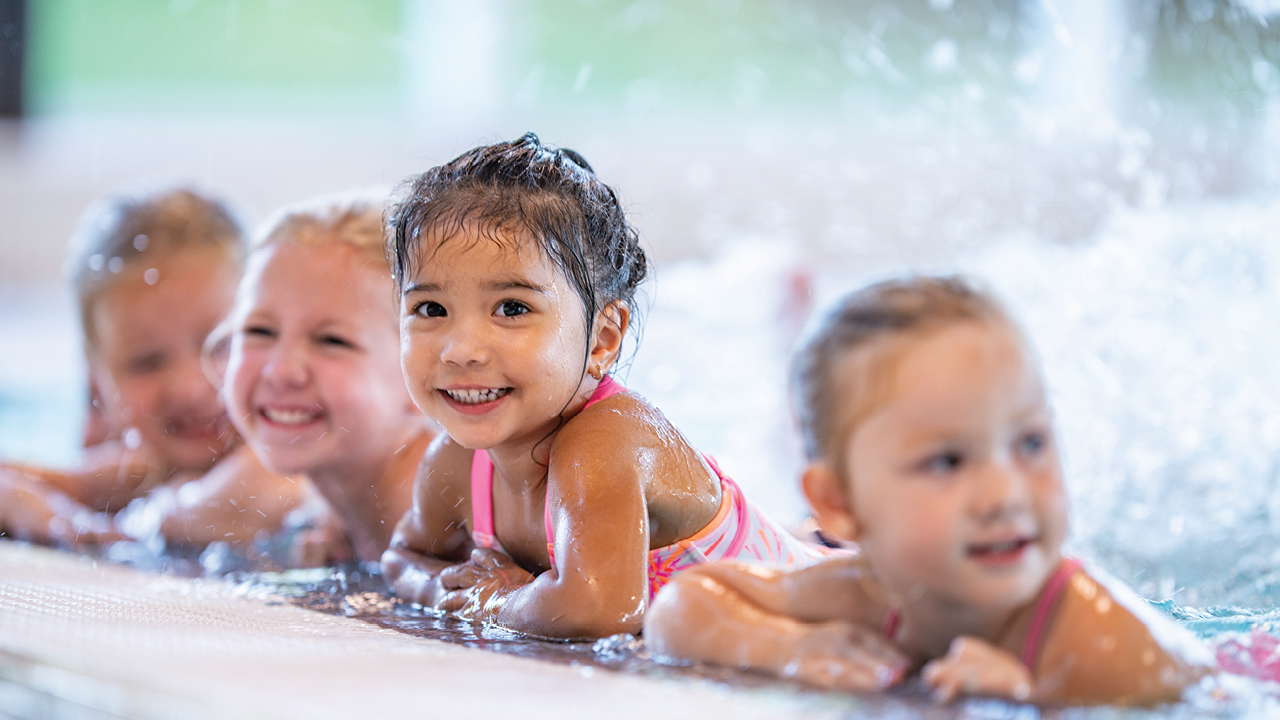
Preschool lessons give children a head start on learning how to swim. Children have fun while gaining foundational water skills and become comfortable in the water. Water Smart® education is incorporated into all Preschool levels to support children in learning how to keep themselves safe in and around the water. Once preschoolers turn 6 years old, please refer to the Equivalency Chart at the bottom of the page for the appropriate next level
Preschool 1 – Octopus
This level transitions the preschooler to the care of the instructor. Preschoolers have fun learning to get in and out of the water assisted by their instructor. Playing games in a safe environment, they’ll learn how to put their face in the water, blow bubbles in the water, and how to float and glide.
Preschool 2 – Crab
Preschoolers work on becoming more independent with their water skills, by learning how to safely jump into chest-deep water and how to swim wearing a PFD. Additional skills include submerging underwater, floating, gliding, and kicking with various buoyant aids.
Preschool 3 – Orca
Preschoolers will kick and glide their way through the water. Learning how to enter deep water safely wearing a PFD, they’ll explore submerging and exhaling underwater, retrieving objects underwater, and continue developing their floating, gliding and kicking skills.
Preschool 4 – Sea Lion
Preschoolers gain some independence in deep water. Learning deep-water entries and treading water wearing a PFD, preschoolers become skilled at retrieving objects from the bottom of the pool in chest-deep water and performing front and side glide. Front crawl wearing a PFD is also introduced.
Preschool 5 – Narwhal
Preschoolers learn Swim to Survive® skills wearing a PFD. Front crawl and back crawl are introduced as well as interval fitness training. Preschoolers also learn how to tread water and perform vertical whip kick with a buoyant aid. Once complete, preschoolers can register in Swimmer 2.
Children
6 to 14 years old
Swimmer lessons are a success-oriented learn to swim program for children 6-14 years old. There is a prominent focus on in-water swimming practice as swimmers learn fundamental strokes and skills, mastering them as they progress through the program. Swimmers also learn how to be safe in, on, and around the water through Water Smart® education incorporated into every level.
Swimmer 1 Intro
An introduction for beginner swimmers who are not yet comfortable in the water. Swimmers will learn how to open their eyes, exhale, and hold their breath underwater, assisted jumps, floats, glides and kicks.
Swimmer 1
Building the foundation of swimming skill development, beginner swimmers will gain confidence in the water as they learn to float and glide independently, and are introduced to jumping and treading in deep water in a PFD.
Swimmer 2
Swimmers will gain comfort in deeper water by jumping in, and learning their sideway entries wearing a PFD. They also learn how to tread water, develop kicking skills, and will be introduced to front crawl and back crawl.
Swimmer 3
Swimmers make a splash learning how to dive, and be challenged with the introduction to more difficult (but fun) skills such as in-water somersaults and handstands to develop weight-transfer skills. They’ll learn Swim to Survive® skills, whip kick on back and will further develop their front crawl and back crawl.
Swimmer 4
Moving from a beginner to intermediate swimming level, swimmers become better at diving, treading water, and swimming underwater. In addition to improving their front and back crawl, swimmers will be introduced to breaststroke, and learn the Swim to Survive® standard.
Swimmer 5
Swimmers master dives and swim in deep water. Swim to Survive® skills, breaststroke, front crawl, and back crawl are further developed, and eggbeater kick is introduced. Interval training and sprinting drills continue to challenge these swimmers.
Swimmer 6
Swimmers become proficient at deep water skills including stride entries and compact jumps. They’ll develop lifesaving kicks such as eggbeater and scissor kick. Breaststroke, front crawl, and back crawl are further developed. Head-up swims, interval training and a 300m workout develop strength and endurance.
Swimmer 7 – Rookie
Laying the foundation of the Swim Patrol program, Rookie includes 4 main components: stroke refinement, fitness, first aid, and lifesaving. Stroke refinement is focused on front crawl, back crawl, and breaststroke. Fitness components include a 350 m workout and 100 m timed swim. Water proficiency skills include swimming with clothes, ready position, and feet-first/head-first surface dives. Swimmers learn and demonstrate the ability to conduct a primary assessment and contacting EMS, rounded off with an introduction to lifesaving skills, including self-rescue techniques, victim recognition, and using throwing assists.
Swimmer 8 – Ranger
Stroke refinement and underwater proficiency continues to be a focus in Ranger as it is critical for supporting swimmer fitness. Focus on enhancing capabilities in the water including stride entries, and underwater forward and backward somersaults. Swimmers learn lifesaving sport skills with a lifesaving stroke medley, timed object support and non-contact rescue with a buoyant aid. Swimmers can expect their fitness levels to increase as they further develop Eggbeater kick and work towards a 200 m timed swim. First aid focuses on unconscious victims and obstructed airway procedures.
Swimmer 9 – Star
Preparing swimmers for the Bronze Star Award, this program challenges swimmers with a 300m timed swim, 600m workout and a 25m object carry. Strokes continue to be refined. Lifesaving skills include use of rescue aids, defense methods, victim removals and supporting a victim in shallow water. First aid focuses on treatment of bone or joint injuries and respiratory emergencies. Once complete, swimmers register into Bronze Star.
Teens & adults
12 years and up
It’s never too late to learn! These programs are for beginners and for swimmers looking to build confidence, refine their strokes, enhance their skills and improve overall fitness.
Stroke Improvement & Fitness (12–16 years)
A fun approach to stroke improvement for lifeguard training or an excellent alternative to the weight room. Teens use goal setting, aiming at improving or maintaining their stroke performance, strength and endurance as well as lifesaving support skills. We recommend students be able to swim continuously for a minimum of 250 metres (10 lengths).
Bronze Star (12–18 years)
Provides excellent preparation for success in obtaining the Bronze Medallion award. Develop problem solving and decision-making skills as they relate to water rescue and first aid as well as Water Smart confidence and the lifesaving skills needed to be one's own personal lifeguard. Completion of Swimmer 9 and ability to swim in deep water is recommended.
Adult 1 (14 years+)
Designed for those new to swimming or looking to improve foundational skills – it’s never too late to learn! You’ll learn safe entries into shallow and deep water, develop skills while wearing a PFD, and learn breath control and underwater skills. Floats, glides, flutter kick and vertical whip kick are introduced. Your fitness will improve through interval training and learning how to perform front crawl and back crawl. WaterSmart® messages are integrated to promote essential safety practices.
Adult 2 (14 years+)
Designed to build on foundational skills with a focus on advanced techniques and endurance. Develop your fitness by working on two interval training workouts, sprints and further developing your front crawl and back crawl. You’ll learn Swim to Survive skills and further develop deep water entries/skills while wearing a PFD. Whip kick is further developed along with an introduction to breaststroke.
Prerequisite: Adult 1
Adult 3 (14 years+)
You’ll master front crawl, back crawl and breaststroke. Continue your fitness training with a 300m workout, sprint challenges and interval training. You’ll learn eggbeater, diving and compact jumps. Further develop treading water and underwater skills.
Prerequisite: Adult 2
Lifeguard certification & vocational training
12 years and up
Dive in and make a difference by teaching people how to swim and be safe in and around the water, as well as how to respond and provide care in emergency situations. We are hiring across 7 City of Burnaby Pools (soon to be 9!), for more information, please visit Burnaby.ca/Lifeguard.
Bronze Star (12–18 years)
Provides excellent preparation for success in obtaining the Bronze Medallion award. Develop problem solving and decision-making skills as they relate to water rescue and first aid as well as Water Smart confidence and the lifesaving skills needed to be one's own personal lifeguard. Completion of Swimmer 9 and ability to swim in deep water is recommended.
Bronze Medallion (13 years+)
Understand the lifesaving principles embodied in the four components of water rescue education: judgment, knowledge, skill and fitness. Rescuers learn self-rescue techniques, defense and release methods, and tows and carries in preparation for challenging rescues involving conscious and unconscious victims of various types, including spinal injuries and circulatory emergencies. Lifesavers develop stroke efficiency and endurance in a timed swim.
Prerequisite: must be 13 years old or have Bronze Star and be 12 years old
Bronze Cross (13 years+)
Designed for lifesavers who want the challenge of more advanced training, including an introduction to safety supervision in aquatic facilities. Swimmers develop proficiency at performing patient assessments, managing aquatic spinal injuries and preventing loss of life in a variety of aquatic emergencies, while developing stroke endurance and fitness training skills. Includes the CPR-C certification and is one of the prerequisite awards for all advanced Lifeguarding and Leadership training programs. It is also worth two Grade 11 high school credits.
Prerequisite: Bronze Medallion.
National Lifeguard Pool (15 years+)
The National Lifeguard Pool certification is designed to develop the fundamental values, judgment, knowledge, skills and fitness required by lifeguards. This course emphasizes the lifeguarding skills, principles and practices, and the decision-making processes that assist the lifeguard in providing effective safety supervision in swimming pool environments.
Prerequisite: Bronze Cross (does not need to be current) and Standard First Aid or Aquatic Emergency Care (current award recommended) by the first day of the NL course from one of the following organizations: Lifesaving Society, Canadian Red Cross, St. John Ambulance, Canadian Ski Patrol, or Heart and Stroke Foundations–certifications from other agencies will not be accepted.
Swim & Lifesaving Instructor (15 years+)
A combination course designed for those who wish to teach the Lifesaving Society's learn-to-swim and lifesaving programs. Candidates are trained using a competency-based model that walks them through teaching and evaluation philosophy and the techniques/approaches required to teach developing swimmers, water rescue, first aid and related aquatic skills. Instructors also learn about long-term and short-term planning, class management, safety supervision, and the principles of evaluation. This course includes a supervised practice teaching component that will better prepare candidates for future job opportunities as an instructor.
Prerequisite: Must be 15 years old by last day of the course and hold a Bronze Cross certificate (need not be current). Must have completed Adapted Swim Instructor Course - Online Session: Meeting the Needs of Diverse Swimmers found on the Lifesaving Society BC & Yukon branch website.
Lifesaving Instructor (15 years+)
Lifesaving Instructor & Examiner prepares Lifesaving Society Swim Instructors to teach and evaluate the Society's Lifesaving programs. Candidates are trained using a competency-based model that walks through them teaching and evaluation philosophy and the techniques/approaches required to teach lifesaving skills. Instructors refine their long-term and short-term planning, class management, safety supervision, and the principles of evaluation. The Lifesaving Instructor Kit ($130) is not included in the course fee and must be purchased at the front desk prior to the program start date.
Prerequisite: Swim Instructor (must have taken the Swim Instructor full course, Red Cross transfers do not count).
Lifeguard School (15 years+)
Prepare yourself for the hiring process. Course includes: NL skills review, fitness training and other important NL skills.
Prerequisite: National Lifeguard certification.
Private lessons
3 years and up
We offer individualized swimming lesson classes ideal for those needing additional assistance in the water or wanting a change from group swimming lessons. Participants are asked to provide the instructor with a previous or current progress card outlining the skills that need additional assistance. This is a great option for people wanting extra time to develop their skills.
Private lessons are recommended for:
- those who require additional attention on a specific skill, or series of skills
- those who need additional in-water support to enhance learning and promote safety
- youth who have not taken lessons for a long time and would like a refresher before taking aquatic leadership courses
- adults who want a practice session prior to registering in adult lessons
Private lessons are not recommended for:
- participants who were unable to complete a level due to an endurance-based issue. Building endurance takes time. The best tip for those with endurance challenges is to sign up for group lessons and practice swimming lengths on their own
- those under 3 years old
Equivalency Chart
Have you taken swimming lessons elsewhere? Take a look at our Equivalency Chart to register for the appropriate swim program.
Please note: If you've completed lessons from another municipality or taken lessons that differ from Burnaby’s Swim for Life program (i.e. private or schoolboard lessons, swim club), please provide their report card prior to registration. You can visit our pool with their report card, email their report card to [email protected] or do a swim assessment so you can register in the right level.
Questions and answers
The Lifesaving Society has been training Canadians to be lifesavers since 1896 in Canada and since 1911 in BC. Over 1.2 million Canadians take Lifesaving Society courses each year. They are a national volunteer-based, not-for-profit organization committed to the prevention of drowning and water-related injury.
As the Canadian Red Cross winds down its swim and lifeguard programming, they’re encouraging all water safety training partners to transition to the Lifesaving Society’s Swim for Life program.
Swim for Life has been offered across the country by the Lifesaving Society since 2007.
Prior to this transition, the Red Cross and the Lifesaving Society (BC & Yukon Branch), had an agreement that in BC, the Red Cross would only offer swim lessons and the Lifesaving Society would only offer lifesaving and lifeguarding courses.
No. The Red Cross Swim program will be retired at the end of 2022. All facilities will no longer be able to use the Red Cross Swim program after December 31, 2022, and will transition to the Lifesaving Society Swim for Life program.
The Swim for Life program focuses on three strokes (front crawl, back crawl and breaststroke). These are the foundation strokes in any swimmer’s repertoire. Specialty strokes such as elementary backstroke will not be part of this new program. Focusing on fewer strokes allows for more practice time during swimming classes. The program asks swimmers to practice their strokes over short distances which allow the swimmer to focus on performing the skill correctly without getting too tired.
The Swim for Life program contains Water Smart® messages in every level.
Lifejackets or PFDs (personal floatation devices) are used by instructors to teach new skills. Using floatation aides as a teaching tool solves some of the most common problems that a swimmer has when they learn a new skill by allowing them to:
- breathe whenever they need
- focus on learning the new movement
- follow the feedback given by the instructor
- rest when they need to
- give themselves feedback on how well they are performing the new skill
When your child feels ready, they can choose to try the skills without wearing a PFD with the instructor’s assistance.
You are not going back a level. You are moving to a different program, into a class that best fits your skill level. Registration in Swim for Life is based on age, ability, skill and knowledge. Because no 2 swim programs are alike, they introduce different skills in different levels. This means that, while many programs use a number system for their levels, the numbers do not line up directly.
Completing Preschool 4 or 5 gives your child the same skills taught in Swimmer 1. They may be ready to try Swimmer 2, especially if they're comfortable in deep water and have strong skills. Swimmer 1 is designed as an entry point into swimming lessons for school aged children who have little or no swimming experience. Preschoolers who have completed Preschool 4 or 5 have mastered glides and have a strong flutter kick, the foundations for learning front crawl and back crawl which are taught in Swimmer 2.
We are offering 9 levels in the children swimming curriculum. The last 3 levels will incorporate Rookie, Ranger and Star programs. These levels introduce kids to first aid and lifesaving training. These courses develop the foundational skills that lead directly into Lifesaving Society programs certifying youths for future employment as lifeguards and swim instructors.
The Swim for Life program recognizes and celebrates each child’s successes with a progress card and a participation badge. Your child will receive these recognition items from their instructor at the end of each session. The accomplishment record will also let you know which level to register in next.