
Electric Vehicles in Burnaby
On August 1, 2026, the City transitioned City-owned public EV chargers from time-based billing to energy-based billing. Learn more.
About this project
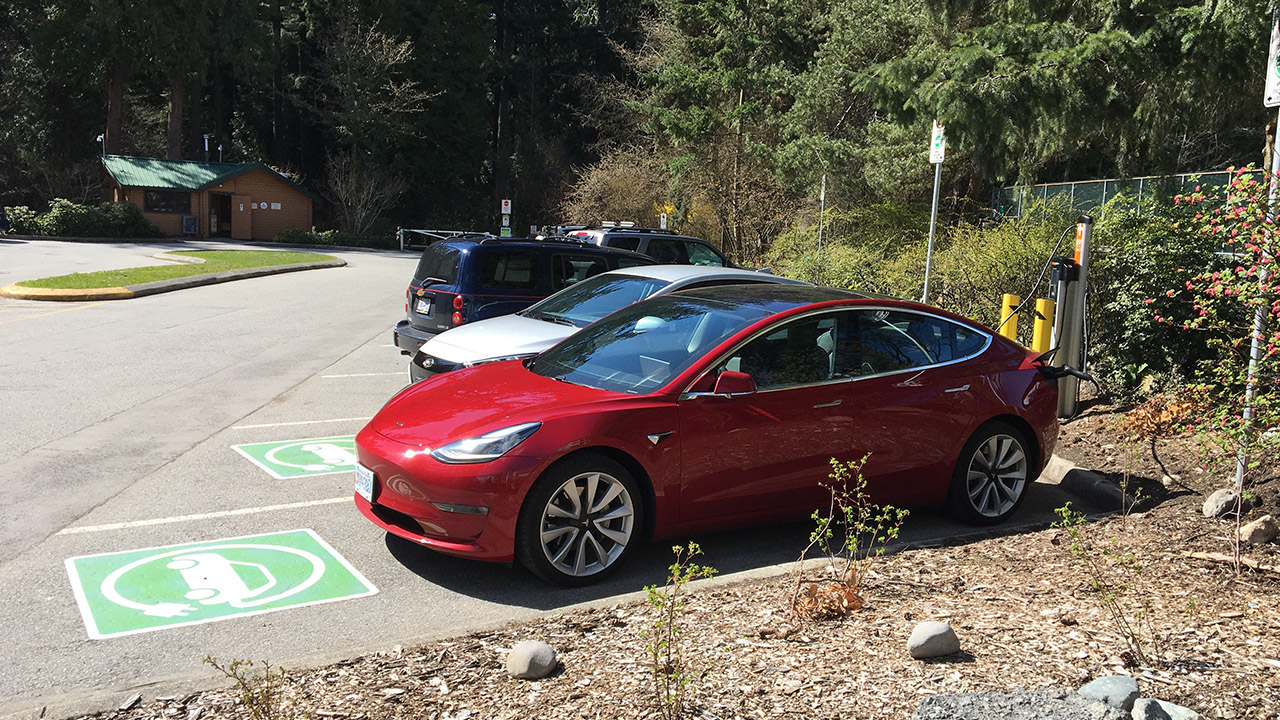
To help meet our climate goals, the City is committed to encouraging electric vehicles (EVs). As EV adoption is increasing in Burnaby, we have developed a Public EV Charging Strategy to meet the needs of Burnaby’s residents, businesses and commuters.
Learn more about the benefits of EVs, the charging stations closest to you, as well as EV charging requirements for new developments.
What's happening now
The City recently received approval from Measurement Canada to move to an energy-based billing model for its public EV charging stations. Under this billing model, users are charged based on the amount of electricity they use, measured in kilowatt-hours (kWh), rather than the length of their charging session.
On August 1, 2026, energy-based billing became available at City charging stations that support this new billing model. The remaining City-owned charging stations will continue using time-based billing until they are upgraded. There is no change to how users access or use the charging stations.
The new billing model is designed to be fairer and more transparent. Because electric vehicles charge at different speeds, billing by kWh means users pay only for the electricity they receive, regardless of how quickly their vehicle charges.
The City is working to transition all public EV charging stations to energy-based billing over time. This change aligns with industry practices and other public charging providers that bill based on energy consumption.
Public EV Charging Strategy
The Burnaby Public Electric Vehicle Charging Strategy was approved by City Council in December 2024, and can be viewed below.
During summer 2024, we collected feedback from the community to understand transportation preferences, current EV use, future EV interest and public EV charging opportunities. Thank you to all who provided feedback. To learn more about the results collected through the engagement process, please review the What We Heard report below.
Have questions on the Public EV Charging Strategy? Contact [email protected].
Learn more about EVs
The City operates EV charging stations in multiple locations. Charging stations can be used for a modest fee (see rates below). The sites are as follows:
|
Location |
No. of charging spaces |
|---|---|
| Bell Park | 2 |
|
4 |
|
|
4 |
|
| Burnaby Art Gallery | 4 |
|
2 |
|
|
Central Park tennis courts |
2 |
| Central Park parking lot (off Patterson Ave at Kingsway) | 2 |
|
City Hall public lot |
2 |
| City Hall West Building fleet lot | 8 |
| Deer Lake 1 | 6 |
| Deer Lake 2 | 4 |
| Edmonds Community Centre | 4 |
| Edmonds Park | 2 |
| Fire Station 4 | 2 |
| Fire Station 8 | 2 |
| Laurel Street Works Yard | 14 |
| MacDonald Ave and Hastings St | 2 |
|
2 |
|
|
2 |
|
| Rosemary Brown Recreation Centre | 31 |
| Shadbolt Centre for the Arts (on-street) | 2 |
| Rowan Avenue Child Care Centre | 2 |
View a map of all public EV charging stations
City-owned stalls work on a pay-per-charge basis plus any applicable parking meter rates.
| Station | Cost | Idle fee* |
|---|---|---|
| Level 2 charging | $0.2865 per kWh | $0.08 per minute after 5 minute grace period |
| Level 3 charging | $0.3479 per kWh | $0.40 per minute after 5 minute grace period |
*An idle fee applies between 6 am and 10 pm, after charging is complete. The fee encourages drivers to move their vehicles and make the charger available for others. No idle fee applies overnight between 10 pm and 6 am.
Note: This change applies only to City-owned and operated charging stations that support energy-based billing. Private charging providers set their own pricing models and billing structures. Please check with the service provider for details.
Download the ChargePoint mobile app to check for available charging stalls.
Please report any problems with charging stations using the ChargePoint mobile app.
- Buying an EV can qualify you for provincial and federal government incentives. You may be eligible for up to $4,000 off an EV depending on income levels. And, if your old car qualifies for the BC Scrap-It Program, you may receive a further rebate.
- EVs are environment-friendly and produce fewer greenhouse gases than regular gas-powered vehicles.
- EVs save you money on fuel and maintenance costs.
- EVs are energy-efficient, quieter, smoother and reduce noise pollution on our roads.
- EVs are low maintenance—reduce your trips to the mechanic.
- EVs enjoy access to high occupancy vehicle lanes (HOV) across BC.
Charging times depend on the battery size and the level of the EV charging station. For instance:
- Level 1 uses a 120-volt system (like a standard house plug) to charge an EV in 8-20 hours.
- Level 2 uses a 208-240 volt system (like a clothes dryer) to charge an EV in 3-10 hours.
- DC fast chargers use a 480-volt direct current system to charge an EV in less than an hour.
New developments must be EV-ready
Burnaby’s Zoning Bylaw has been updated to encourage electric vehicle adoption and reduce carbon pollution from private transportation. All new development, both residential and non-residential buildings, are required to be EV-ready. Ensuring convenient access to EV charging makes it easier for residents and businesses to choose electric vehicles. Installing charging infrastructure at the time of construction is more cost-effective than retrofitting a building later on.
Effective September 1, 2018, 100% of parking spaces in new residential buildings, including single, two and multi-family dwellings must include Level 2 EV charging infrastructure.
Buildings with shared parking (i.e., apartments, condos, some townhomes) that use EV energy management systems (EVEMS) or “load sharing” can be used to meet the requirements to reduce costs and minimize impact on the utility grid. An EVEMS must ensure that every EV charging outlet receives at least 12kWh over an 8-hour period, the minimum performance standard.
These requirements do not include the EV charging station (only energized outlet).
Effective July 8, 2024, all new non-residential developments require that a minimum of 45% of total parking spaces are to be EV-ready as follows:
- 10% of parking spaces are EV-ready (Level 2 without EVEMS)
- where an EVEMS must ensure that every EV charging outlet receives at least 12kWh over an 8-hour period, the minimum performance standard.
- 35% of parking spaces are EV Ready (Level 2 with or without EVEMS)
With:
- 100% of accessible parking spaces are EV-ready (Level 2 with or without EVEMS)
- accessible stalls are included within the 45%
- 100% of Shared Vehicle Organization parking spaces (Level 2 with or without EVEMS and includes a minimum of one Electric Vehicle Supply Equipment (EVSE)
- any shared vehicle parking space is counted separately from the 45% minimum requirement
Helpful resources
- City of Burnaby's technical bulletin includes details to guide installation of the required EV charging infrastructure, in order to meet the requirements of the Zoning Bylaw.
- City of Burnaby's guide for Mechanical Equipment Installation and Retrofits in Existing Multi-Unit Residential Buildings.
- The Incentive for Zero-Emission Vehicles (iZEV) Program makes you eligible for a point-of-sale incentive when you purchase or lease qualifying zero-emission vehicles after May 1, 2019.
- The Clean Energy Vehicles for BC Program makes clean energy vehicles more affordable for British Columbians.
- Plug-In BC provides basic information about EVs and incentives for purchasing EVs and installing EV charging in your strata or workplace.
- Plug-Share BC provides an interactive map of locations to charge your EV.
- EV Condo provides condo residents and owners with resources and information about setting up EV charging and a searchable map of EV-friendly condos in Metro Vancouver.
- BC Hydro provides information about EVs in BC is ready for Electric Vehicles and their guide for Installing EV Charging Infrastructure in Shared Parking Areas.
- The New Clean BC program offers provincial rebates for the purchase and installation of EV chargers and infrastructure.
- BC Hydro Alliance program where residents and businesses can get a referral for EV charging installation.
Ask a question
Contact us
Climate Action and Energy