
Planning to develop property in Burnaby? Find the information needed for obtaining approvals as an owner, developer, or builder.
Zoning Bylaw & Official Community Plan
Understanding how a property may be used today and in the future is an important step when exploring development potential. Information about current zoning, future land use and development permit areas can be found by doing a property search using Burnaby’s interactive mapping application.
The Burnaby Zoning Bylaw regulates the types of activities permitted on a property and the size and location of buildings, structures and uses.
The Official Community Plan (OCP) presents a long-term vision for the community. It provides the strategic direction, framework and guidance to meet the anticipated needs of the community while ensuring Burnaby is an even more desirable place to live, work and invest in the future.
Development process and guides
Land Use Applications & Permits
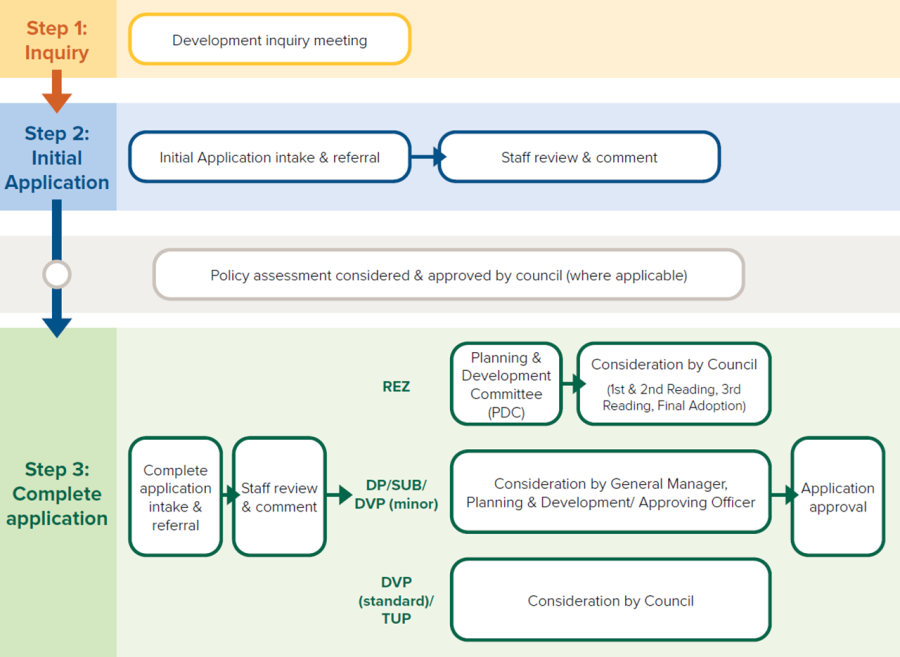
The Development Application Guide provides a detailed summary of the application process for Development Inquiry, Initial Application, Rezoning, Subdivision, Development Permits, Temporary Use Permits, and Development Variance Permits. Generally, the approval process includes three steps as outlined below:
Development Inquiry Meeting
A Development Inquiry Meeting is a preliminary meeting where City staff review a proposal, provide general feedback on its supportability, and identify required applications, submission materials, and applicable bylaws and policies. A Development Inquiry Meeting is not mandatory, but it is strongly recommended in advance of submitting an Initial or Complete Application.
Submission requirements include:
- Subject site address(es)
- Letter of Intent (including project description)
- Preliminary site plan
- Building concept (if available)
- Subdivision plan (if available)
To request a Development Inquiry Meeting, please email [email protected] with the required documents attached. Inquiry meetings are usually held within 2 weeks of the request, either virtually or in person at Burnaby City Hall.
Initial Application
An Initial Application is a precursor application that enables a streamlined review process to identify key issues and requirements. This is a formal process, with an application fee, and it is required in advance of a Complete Application for an OCP amendment, rezoning, development permit (other than on lots zoned R1 – SSMUH), and select building permits. Building permit applications that involve a principal use on a lot within the Public and Institutional (P1, P2) or Agriculture (A1) Districts, and have not already completed an Initial Application, will be required to do so before the Building Permit application may be submitted.
Submission requirements are outlined in the Initial Application Submission Checklist. To submit an Initial Application please email all required documents to [email protected].
An Initial Application is typically completed within 6-8 weeks once all required documents have been submitted.
Complete Application
Rezoning is the process of legally changing a property’s zoning designation through a bylaw amendment. A rezoning application is required when a proposed use, density, or building form does not comply with the property’s existing zoning requirements. Submission requirements are outlined in the Complete Application Submission Checklist. To submit a Rezoning Application please email all required documents to [email protected].
The overall timeline depends on the complexity of the application and the applicant’s readiness to meet the prescribed conditions. Below are the approximate processing times for reference:
- Rezoning application: 10-18 months
- Master plan rezoning application: 12-24 months
Subdivision is the legal process of altering property boundaries, approved by a municipal Approval Officer. A subdivision application is required when there is a change in one or more of the existing property lines and/or a property line is being added. The following are examples of when a subdivision application is required:
- Divide land into smaller parcels
- Realign existing boundaries
- Consolidate properties into a single lot
- Airspace parcelization
- Stratification or phased stratification
Submission requirements are outlined in the Complete Application Submission Checklist. To submit a Subdivision Application please email all required documents to [email protected].
Overall processing time depends on the complexity of the subdivision and the applicant’s responsiveness. On average, subdivision applications take approximately 6-12 months to complete.
For larger lots, buildings and structures should be located strategically to allow for potential future subdivision. This includes considering appropriate setbacks, site layout, access and servicing to ensure the property can be divided into additional parcels in the future.
Subdivision Inquiry
If you are looking for confirmation regarding whether a proposal for subdivision could be supported by the Approving Officer, you may submit a subdivision inquiry by emailing [email protected] with the following information:
- A formal letter including details of the number of additional properties proposed, the number of proposed units on each property and whether any existing buildings are proposed for retention,
- A draft Subdivision Plan, prepared by a surveyor showing the proposed property lines and proposed units, and/or buildings proposed for retention,
- A Building Scheme, applicable to corner lot subdivisions proposing a change in lot direction, that is not in line with the prevailing lot pattern. The following information is to be included:
- number of buildings and units per proposed new lot;
- location and size of parking spaces (dimensions and area);
- location and size of outdoor area per unit (dimensions and area); and
- dimensions and area of building/unit footprints to determine lot coverage (percentage) per proposed new lot.
- An Agent Authorization Form signed by the owners, allowing you to submit the inquiry on their behalf Once the above items have been submitted and the applicable fee has been paid, the inquiry will be assigned to a Case Manager. A formal response will be provided within 8 weeks of receiving a complete submission.
Once the above items have been submitted and the applicable fee has been paid, the inquiry will be assigned to a Case Manager. A formal response will be provided within 8 weeks of receiving a complete submission.
A Development Permit is a permit issued by a local government that regulates how land is developed. A Development Permit is required in certain areas of the City, as outlined in the Official Community Plan, to ensure new projects meet specific standards for design, environmental protection, and tenant protection. The City of Burnaby currently has three Development Permit Areas with associated guidelines.
- Form and Character: A Form and Character Development Permit is required for most new buildings, major additions, or significant exterior alterations to residential, commercial, employment, industrial or mixed-used developments.
- Streamside Protection and Enhancement: A Streamside Protection and Enhancement Development Permit is required when development activities such as subdivision, construction, or land alteration are proposed near a stream or a feature that may be classified as a stream.
- Tenant Protection: A Tenant Protection Development Permit is required when a purpose-built rental building, with 5 or more units, is proposed for redevelopment.
Development Permits are generally not required for properties zoned for institutional (P1, P2), agriculture (A1), or small-scale multi-unit housing (R1). However, properties zoned R1 Small-Scale Multi-unit Housing District may still require a Streamside Protection and Enhancement Development Permit, if located in proximity to a feature that may be classified as a stream, or within the Streamside Development Permit Area. If your property is located within a designated Development Permit Area and it does not meet any associated exemptions, you must obtain a Development Permit before starting any development.
All the three development permit area guidelines can be found in the Zoning Bylaw and are linked below:
- Form & Character Development Permit Guidelines
- Streamside Protection and Enhancement Development Permit Guidelines
- Tenant Protection Development Permit Guidelines
Submission requirements are outlined in the Complete Application Submission Checklist. To submit a Development Permit Application please email all required documents to [email protected].
Depending on the complexity of the site, and the number of required Development Permits, the application is typically completed within 8-10 months once all required documents have been submitted.
A Temporary Use Permit (TUP) is a permit issued by a local government that allows land to be used for a specific purpose on a short-term basis that is not normally permitted under zoning regulations. A TUP is required when a proposed use does not align with existing zoning, and there is a desire to only permit the use temporarily. TUPs are valid for up to 3 years and may be renewed once for an additional maximum 3 years.
TUPs are generally not supported for liquor and cannabis-related uses, or on properties with the following designations and land uses:
- Land within the Agricultural Land Reserve
- Residential properties, including:
- Purpose-built rental housing
- Small-scale multi-unit housing
- Rowhouse, townhouse or apartment dwelling
- Secondary suite or lock-off unit
- Properties designated “Industrial” in the OCP, unless for uses permitted in the Employment and Industrial Districts, excluding:
- Office
- Restaurant
- Indoor athletic recreational uses
- Indoor go-cart tracks
- Indoor pistol and rifle ranges
Submission requirements are outlined in the Complete Application Submission Checklist. To submit a Temporary Use Permit Application, please email all required documents to [email protected]. These applications are typically processed in about 6 months.
A Development Variance Permit (DVP) is a permit issued by a local government to vary certain requirements of the Zoning Bylaw or Sign Bylaw. A DVP is required to vary elements including, but not limited to:
- Minimum building setbacks and separation requirements
- Maximum retaining wall or fence heights
- Minimum off-street parking and loading requirements
- Landscaping requirements
Note: Use, density, rental tenure, and floodplain requirements cannot be varied through a DVP.
Minor Variances
- Minor variances include any variance to signage requirements, or a variance that is up to 50% (25% for building heights) of the minimum or maximum requirement. Minor variances are approved by the General Manager, Planning & Development. ;
- These applications are typically processed within 2–4 months, and owners can request Council reconsideration within 10 days of the decision.
Standard Variances
- Standard variances apply to variances greater than 50% (25% for building heights) and require Council approval. Council may approve, request changes, or refuse the variance requests.
- These applications are typically processed within 6 months.
Submission requirements are outlined in the Complete Application Submission Checklist. To submit a Development Variance Permit Application please email all required documents to [email protected].
Board of Variance
Board of Variance is another option that applicants have to request minor exceptions to zoning regulations. BOV handles requests for minor sitting or size changes (not use or density) where strict compliance with zoning regulations would cause undue hardship. A Board of Variance application must include a referral letter from the Building Division during the review of building drawings.
Submission requirements
Application Documents and Fees:
Other permits and processes
A Sign Permit is required for any structure or advertising device that is visible from a street and intended to attract public attention. Signs may be installed in a variety of locations, including on an awning or canopy, on the face of a building, on a roof or window, or as a free‑standing sign.
The City offers incentives to protect heritage buildings through the Heritage Planning Program.
The City is not currently accepting applications for new private retail cannabis stores in Burnaby. Once the review of the Liquor and Cannabis Licensing Policy is complete in 2027, new applications may be considered.
Related bylaws and policies
- Bylaw Number: 14646 - Amenity Cost Charges Bylaw 2024
- Bylaw Number: 13658CC - Building Bylaw 2016
- Bylaw Number: 14762 - Burnaby 2050 Official Community Plan
- Bylaw Number: 13809CC - Business Licence Bylaw 2017
- Bylaw Number: 14645 - Development Cost Charges Bylaw 2024
- Bylaw Number: 14824 - Burnaby Development Procedures Bylaw 2026
- Bylaw Number: 14834 - Sign Bylaw 2026
- Bylaw Number: 12875CC - Solid Waste and Recycling Bylaw 2010
- Bylaw Number: 5953CC - Subdivision Control Bylaw 1971
- Bylaw Number: 14821 - Tenant Protection Bylaw
- Bylaw Number: 14665 - Transit-Oriented Areas Designation Bylaw 2024
- Bylaw Number: 10482CC - Tree Bylaw 1996
- Bylaw Number: 14683 - Waivers and Reductions of Amenity Cost Charges and Development Cost Charges Bylaw 2024
- Bylaw Number: 14829 - Works and Services Bylaw 2026
- Bylaw Number: 14485CC - Consolidated Fees and Charges Bylaw
- Bylaw Number: 14815 - Zoning Bylaw (Community Benefit Bonus, Inclusionary Rental Requirements)
- Adaptable Housing Policy
- Child Care Policy
- Climate Action Framework
- Community Plans
- District Energy Policy
- Economic Development Strategy
- Environmental Sustainability Strategy
- HOME: Housing and Homelessness Strategy
- Liquor and Cannabis Licensing Policy
- Mid-block Connection Policy
- Private Sector Public Art Guidelines
- Social Sustainability Strategy
- Sound Criteria (for Acoustical Reports)
- Transit-Oriented Development Areas Transportation Demand Management Guidelines
- Transportation Plan
Please note: This is a partial list of planning-related policies and is intended for reference only.
- ALC: Agricultural Land Commission Act
- Coast Mountain Bus Company (Translink)
- BC Hydro
- Fraser Health: Community Care Facilities Licensing
- Ministry of Transportation and Transit (MOTT)
- NavCanada: Airport Zoning Regulation
- NavCanada assesses land use proposals near airports and air navigation infrastructure. Visit the NavCanada website for submission requirements and to submit a proposal.
- Telus
- Transmountain
How to pay
You can pay invoices online with your credit card (Visa, MasterCard, American Express) or in-person with cash, cheque or debit card. Per the City's Fee Recovery Bylaw 13640, we'll charge a fee of 1.8% on payments made with a credit card.